Categories
- Business Objects (3)
- Best Practices (2)
- Fusion Charts (5)
- Main (3)
- SQL Server (1)
- SSIS (1)
- Uncategorized (1)
- Universe Design (3)
- Web Intelligence (4)
- Xcelsius (12)
- Design Practices (3)
- Excel (2)
- Tips and Tricks (4)
- Workarounds (1)
Archives
- July 2010
- May 2010
- April 2010
- March 2010
- February 2010
- January 2010
- October 2009
- August 2009
- April 2009
- March 2009
- January 2009
- December 2008
- November 2008
- October 2008
Tag Cloud
auto increment
best practices
bonavista
bulletgraph
Business Objects
charting
charting package
conditional formatting
content management
dashboard
datatable
dianne sawyer
dom
Excel
expand
fannie mae
fix
flash charts
fred carter
frederick carter
free
Fusion Charts
grid component
imt slider
inovista
java
javascript
Java Wrapper
microcharts
pathway technologies
populate dimension table
ripoff
scam
sorting
sparkline
SSIS
table
tree grid
universe
User Access
User Management
Web Intelligence
wrapper
Xcelsius
Xcelsius 2008
Latest Tweets
-
Using Filtered rows instead of VLOOKUPS in Xcelsius @
http://davidlai101.com/blog/2010/07/02/using-filtered-rows-instead-of-vlookup/ - posted on Jul 03, 2010
-
New Post on the Xcelsius Push Button Object @
http://davidlai101.com/blog/2010/05/29/xcelsius-push-button/ - posted on May 29, 2010
-
Xcelsius dynamic color binding article and video posted @ http://davidlai101.com/blog/2010/04/06/xcelsius-dynamic-color-binding/ - posted on Apr 06, 2010
-
New post on Xcelsius Canvas Containers @ http://davidlai101.com/blog/2010/03/26/xcelsius-canvas-container/ - posted on Mar 26, 2010
-
Guide on Business Objects access levels posted http://davidlai101.com/blog/2010/02/19/understanding-business-objects-access-levels/ - posted on Feb 19, 2010


Best Practices for Organizing and Naming Objects
While working with many Universes, I’ve noticed that sometimes not enough attention is given to naming objects and the ordering of objects. This in turn may cause confusion with the business users since they are not completely clear on what each of the objects do.
Ordering of objects
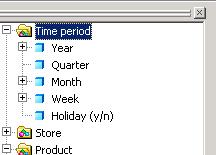
When you have objects of the same class grouped together, it makes it much clearer to the business user to view when they see it in a hierarchal form instead of alphabetically. Lets take for example date objects. We have a year, quarter, month, and day object. The largest increment or grouping should always appear at the top and the most detailed at the bottom. Having this ordering will facilitate drilldowns. If these were sorted alphabetically, a business user would have to do more work in order to come up with a drilldown hierarchy.